"Journal"
Another iPhone Story
A must watch short documentary from WSJ, named so aptly “Behind the Glass”. The story behind iPhone’s journey to existence will keep fascinating us, coming out every now and then, bite-sized.
A must watch short documentary from WSJ, named so aptly “Behind the Glass”. The story behind iPhone’s journey to existence will keep fascinating us, coming out every now and then, bite-sized.
Such a refreshing edit this published as part of Sunday Review at The New York Times. The contrast between people’s real lives and ones as perceived by their “friends” on social media is so succinctly articulated by Seth Stephens-Davidowitz. Especially evident is the side of us exposed to Facebook as against Google (the search engine).
Alone with a screen and anonymous, people tend to tell Google things they don’t reveal to social media; they even tell Google things they don’t tell to anybody else. Google offers digital truth serum. The words we type there are more honest than the pictures we present on Facebook or Instagram.
Sometimes the contrasts in different data sources are amusing. Consider how wives speak about their husbands.
On social media, the top descriptors to complete the phrase “My husband is …” are “the best,” “my best friend,” “amazing,” “the greatest” and “so cute.” On Google, one of the top five ways to complete that phrase is also “amazing.” So that checks out. The other four: “a jerk,” “annoying,” “gay” and “mean.
I just could not have put this is in a better way. The fakeness of what streams at Facebook has always been at the crux of the platform being disliked by a vocal minority, especially the geeks. It won’t be too much of a stretch for the argument to say if it is not fake, it is not visible on the Facebook timeline.
How does one protect oneself from getting miserable at the hands of this streaming pile of curated noise?
Once you’ve looked at enough aggregate search data, it’s hard to take the curated selves we see on social media too seriously. Or, as I like to sum up what Google data has taught me: We’re all a mess.
Now, you may not be a data scientist. You may not know how to code in R or calculate a confidence interval. But you can still take advantage of big data and digital truth serum to put an end to envy — or at least take some of the bite out of it.
Any time you are feeling down about your life after lurking on Facebook, go to Google and start typing stuff into the search box. Google’s autocomplete will tell you the searches other people are making. Type in “I always …” and you may see the suggestion, based on other people’s searches, “I always feel tired” or “I always have diarrhea.” This can offer a stark contrast to social media, where everybody “always” seems to be on a Caribbean vacation.
Yep, the best lifehack I have read in a long long time. Amen.
There is a great edit on Ars Technica about “The secret lives of Google raters”. I found the section on how there always are some people, humans, behind all the AI Google, and Facebook, want to harp about. Following passage is a sheer eye-opener.
UCLA Information Studies professor Sarah Roberts has been studying the lives of raters for the past five years, traveling from California to the Philippines to interview workers. She told Ars that one constant in all their stories is that these workers feel isolated from the companies like Google and Facebook, even though most of their work benefits them. Some say that they know they work for Google, but Google doesn’t know they work there.
Roberts believes that big companies like Google want to keep raters hidden, largely because they like to boast about how many tasks they handle with AI. “Actually their AIs are people in the Philippines,” she told Ars by phone. “Are there algorithms in all these tasks? Sure. Is it 100 percent? Not even close. There’s some kind of profit motive behind these claims [about how] machines and algorithms run the show.”
The plight of these raters is real. For all the advancements in AI and automation, there is always some “dirty” work that’s deemed too unimportant, too trivial, to only be pushed “down” to humans. The trend is disquieting.
“Very few books make me root for the central character. Ove has me hooked.. am with him for a fun ride!” That was my update a third into the book. And boy, did this guy keep me hooked. I was with him as his past unfolded in front of me. I was with him as his present life was amended by some funny, some happy, some sad events. Above all, I was with him as this grumpy old sod grew into a grumpy, but caring, grandad.
Author, Fredrik Backman, allows the characters to grow and that is the biggest reason the book worked for me. There is no haste in revealing the past or bumping into Ove’s future. Every chapter, a short story in itself, unfolds more of Ove and the world around him. You see Ove as he is. You are slowly led to understand why he is the way he is, mostly via flashbacks. You are made to feel for the guy, made to root for him to not stay how he is. And when that happens, because you are already absorbed into Ove’s life, you are left contented.
Saying Ove is grumpy would be an understatement. He is on the edge always, ready to get worked up. He is disappointed in everyone around him. He feels no one is responsible enough to care for oneself - dependent on others for every little thing. He feels the world around has no respect for rules of the land, doesn’t matter they are chalked out by Ove himself. So he takes it upon himself to make sure people are constantly reminded of that. And that’s how he lives his life - a monotonous, misanthropic one . And as Ove is planning to end his troubles with his life, fate has just the opposite planned for him — to add just enough goodness in Ove’s life to thaw the bitterness.
The book maintains a wry sense of humor throughout. It made me laugh out loud at multiple instances. Especially, the way Ove’s frustrations in other people’s incompetence are worded is an absolute masterclass. The book also maintains a deep sad undertone. It does not ever let Ove’s sulkiness make you hate him.
So be it through his affection towards a young boy in love or forced, but welcome attachment from the lively new neighbor or the unspoken responsibility towards the old, and may be the only friend, Ove always shows just enough warmth to make him the most likable character in a long long time. Or in Sonja, Ove’s wife’s words, “the strangest superhero I have ever heard about”.
Go welcome this guy, and the gang, into your life. He will make you smile, guffaw, shed a tear and, above all, enlighten you towards life. A must read.
My Rating: 5 of 5 Stars
It was pitch dark across the town of Diu. The street winding down was deserted as usual. It had recently been washed off its weariness by the unseasonal rain. In a way, it was a perfect setting for one pleasant, romantic walk.
A couple silhouetted against the discontinuous bouts of illumination from the lighthouse nearby. But their walk was no way romantic, may be a tad tipsy rather.
Roy and Joel had been walking down the street for almost an hour. Yet their individual opinions were divided. Joel thought it must have been four hours. Roy, however, opined that he was off by at least 3 hours and 30 minutes.
“No way” bawled Joel, “We must be just debating this for last 2 hours.”
“Again, you are off by an hour and 30 minutes at the least” Roy countered.
“How are you so sure? It’s as if you want to stay here longer.”
“Of course, I do. Don’t you?”
“Well, not in the shape I am now” Joel hit back with his fiery eyes. “Anyway, shouldn’t we be searching for what we are supposed to search?”
“That is exactly what I am doing” replied Roy, peeking at the byroad they were passing by.
“I don’t think we are searching for the same thing, though. If that were the case, you would be peeping minutely down the manholes. Not glancing at the lanes as we pass by.”
Roy just smiled.
Ganu saw the two bodies tottering along. He wasn’t sure if it was their walk or his drunk vision that was unsteady.
One was looking minutely at the footpaths, and in the garbage bins, and over the plant pots. He thought he also saw him once peeping inside a manhole. He was for sure searching for something.
The other, the skinny one, was not searching for any thing, though. “He might well be searching for someone.” thought Ganu.
There was something about these two people that appeared odd to Ganu. They looked unconventionally fresh for the time of the day, the season of the year, and the condition of the city. All were in shambles.
Ganu did not like such clean people. He felt no one should be this clean when he was drowning in his sorrows.
Ganu started following them.
“I think that guy there is following us. Is it ok if he sees us?” asked Joel, in a worried tone.
“How would I know? I too am going through this for the first time. I, anyway, do not think anyone ever has faced this. I think even he would not know.”
“Of course, he would know. He is the one who sets the rules.”
Roy shushed Joel as he heard the muffled voices, the wailings. He walked towards the next alley — there was a gathering of saddened souls.
Roy just smiled, again.
Ganu walked behind them to the crowd and steered himself towards the middle. He saw the back of the skinny one now, looking down at a weeping woman. And just as he saw what lay unmoving on the ground in front of her, he collapsed with his eyes wide open.
“Oh, crap!” exclaimed Death. “Now this hasn’t happened ever.”
He looked at Roy, Joel, and the other souls. “Well people, the only way in now is down. Let’s go search for that key to the heavens.”
Maciej Cegłowski rants on how IFTTT pulled the plug and dropped the support for Pinboard.
Imagine if your sewer pipe started demanding that you make major changes in your diet.
Now imagine that it got a lawyer and started asking you to sign things.
You would feel surprised.
This is the position I find myself in today with IFTTT
This has to be one of the best break-up lines ever used. There is a bit of disdain for IFTTT in Maciej’s tone, but his anger is justified. When your whole business is driven by the content that exists at other freestanding services, you do not govern the terms the said services should operate in.
Maciej has already levied against IFTTT, or as he defines it, “the Internet plumbing that has been connecting” web services - recommending alternative services to his users. I, for one, am going to continue with IFTTT. I know they have put a misstep, but am hopeful they will learn from it.
Update: Armin Ronacher has perfectly captured why I feel it is a misstep from IFTTT in his tweet.
The entire point of @ifttt was that they bridge APIs. Outsourcing their entire point of existence to the API providers seems moronic.
— Armin »not the flu« Ronacher (@mitsuhiko) March 29, 2016
Ev Williams suggesting an idea for a new age messaging app to overcome the rush of frantic messaging.
A messaging service/app that only delivers once per day (say, noon). It’s like going to the mailbox and seeing what’s there for you.
It's an interesting idea in principle. But it would not work in reality. Here are my few quick thoughts.
I think it would be interesting to follow the positive effects of this "forced limitation" — things that might make this experiment succeed.
However the limitations would force the user to see the not-so-good side of the social interaction.
Forced limitation is the stick, but where’s the carrot?
Emma Watson gave an impassioned and effective speech at the U.N. headquarters in New York. The address was as part of the launch of “HeForShe” campaign.
Overall speech from the U.N. Women Goodwill Ambassador is a must watch — not only for the fact that it was highly applauded & admired, but for a fresh view towards Feminism.
I was especially gratified to hear her speak on why gender equality is an issue, and a cause of concern, for men too.
Gender equality is your issue too. Because to-date, I have seen my father’s role as a parent being valued less by the society — despite my needing his presence as a child as much as my mother’s. I’ve seen men suffering from mental illness unable to ask for help for fear it will make them less of man.(…) I have seen men made fragile and insecure by distorted sense of what constitutes male success.
Men don’t have the benefits of equality either. We don’t talk often about men being imprisoned by gender stereotypes. But they are. And when they are free, things will change for women as a natural consequence.
If men don’t have to be aggressive in order to be accepted, women won’t feel compelled to be submissive. If men don’t have to control, women won’t have to be controlled. Both men and women should feel free to be sensitive. Both men and women should feel free to be strong.
It is time we all perceive gender on a spectrum instead of two sets of opposing ideals. If we stop defining each other by what we are not and start defining ourselves by who we are, we can all be freer.
Complex topics are rarely worded more succinctly. Respect for Emma Watson and empathy for the gender equality fight has risen manifolds in my mind.
Do watch the complete video and contemplate.
Such a letdown by the finale. Last third of the book completely ruined the build-up — which itself wasn’t too great. But this could have been so much better if the author did not fall for the pressure to jack up the number of pages — the effort, to stretch the story unnecessarily, clearly shows.
It’s all about the impending war. Amish can write battles well. But he struggled to put the battles together into an interesting story. Towards the end it was just a drag. There was no thrill, there was no surprise, there was no story remaining. It was just an attempt to conclude the trilogy, a miserable attempt at best.
There are too many characters, each seeking a closure of his own - leading to too many unnecessary side stories. Further surprising is no character behaves the way you expect them to behave. Parvateshwar doesn’t. _Ganesh_doesn’t. Even Shiva doesn’t - the biggest issue.
Sigh. It is not easy to close mystery trilogies. And the frustration at not being clear on how to do so, for Shiva, shows from the plot that unravels — left me fuming.
A side note on the overall series, I am completely baffled by how the tile & summary of the novels set complete different expectations than what the actual plot delivers. It applies for all 3 — realised first with “The Secret of Nagas”.
There was no secret of or from Nagas that was significant to earn a title. This one goes further ahead. At least in the second one, Nagas had significant role. Here, Vayuputras just have no f-ing role at all. It could very well have been some smart brahmin who owned the “nuclear” weapon and it would not have mattered a whit. And Oath? Which f-ing oath are you talking about? Plot goes on irrespective of it exists or not. In fact, one Shiva gives Mithra, he so uncharacteristically breaks.
Sigh! Every word in summary is to hype up the mystery. Titles are completely baseless. Not the right precedent this.
My rating: 2 of 5 stars
A great fun read with extremely witty subplots is how I remember this book. But then I think about it a bit and it is not how I felt throughout.
It is extremely slow, occasionally (just) funny in the initial half. It does have that moment of laugh-out-loud humour in between — but slow nonetheless. So much so that I had lost the interest in between. It was as if jokes were written around characters (mostly caricatures) and thrown in. And the pages filled in describing the fantasy land and the surroundings were too much at times. But that is before the plot picks up and fun kicks in again.
The novel is sheer pleasure after that. I couldn’t put it down and wanted to know what happens next. Frankly, more than what happens, I was interested in how Terry Pratchett words it. I have realised that Pratchett is a master of witty fantasies. It was not that rare when I used to pause and admire how unnaturally a feeling (like fear, anger , etc.) can be described without sounding stupid. If there ever was a university of metaphors, Pratchett would surely be the founder of that. And he would still be teaching a course on thinking big — weird, but big.
So here I am confounded for the first time after reading a book. Do I like the book, the story or do I like the way it is often spun? And it turns out I find the book to be just OK. But then I would pick it up any day, go back to my highlighted passages and admire the mastery at work.
And just for this master Pratchett, I will pick up another of the Discworld novels soon and start taking notes.
My rating: 3 of 5 stars
Every time I read an article online that grabs by attention and interest, I am faced with a dilemma. I feel am gaining something without compensating for what is due to the writer or/and the owner of the website.
I run Ads-block extension. Well, the web publishers are themselves to blame. Look at the following tweet from me and I hope you feel the pain (i.e. if you do not, already).
So I am one less revenue node for the ads-driven sites out there.
I will not be able to pay the subscription price for every individual site I want to visit. That’s like watching, and paying for, television channels á la carte. What worsens the web scenario even further is there are zillions of channels out there instead of few hundreds. And everyone might create just that one interesting episode instead of a long drawn series.
So here's the situation as it stands then.
I do not want to see the ads. Majority, including me, cannot pay for subscriptions.
Ads are hated — considered, and rightly so, blots on the web. Subscriptions are costly, unaffordable.
What choice are the web publishers left with then?
Some time back, I read this interesting post at xkcd, a usual for these guys.
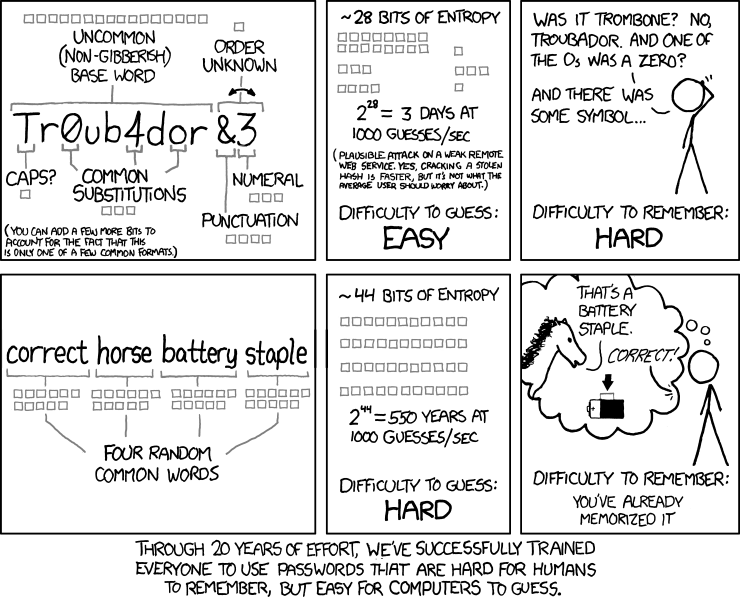
It made me realise, for the zillionth time, passwords are mess. This medium of authenticating a valid, and a human, user has overstayed its welcome. The way it is being used is not secure. Well, can you blame the poor souls who are made to remember the crazy letters every time they want to get something done online? Moreover, they are forced, as a security policy, to change and then remember the new passwords every some time. Sigh! Indeed, passwords are mess.
You need more proof? Try searching for the phrase “passwords should die”. This farce has to be one of the most cursed phenomenon out there.
A lot has been said on this front too. There are articles and even open source frameworks, like Passwordless that want to target this by providing application developers ways to replace their login forms with password-less access. At high-level, key steps involved to achieve this are
These are pretty standard and well accepted steps. However the issue remains in the 3rd step, how should these tokens be delivered. Whichever mechanism one selects will become the single point of threat to the whole system going haywire, be it then email (what’s the password for email account then?) or SMS (phone is lost, what now?). The hacker news thread on one such suggested system is nice rundown for the probable issues.
Now that thread is more than a couple of years old. Today, the best option would be to deliver the token to the device which has biometric authentication enabled. As an example, I really like the way Apple has enabled the two-factor authentication on Apple Id. It displays possible devices where the token can be delivered and asks the user to select one. Once delivered to, say, an iPhone, only the user who owns the iPhone can access it by authenticating himself with TouchId. This same mechanism can be applied for delivering the secure tokens of web/mobile applications too. There, the delivery problem is solved.
However, given that majority of the users do not own an iPhone or a similar biometric authentication enabled device, this method cannot become the primary way of authenticating users.
So even though I believe that, in John Siracusa’ words, on an infinite timescale, all applications will have password-less logins, we are some years away from realising that dream.
Ok, so what till then? This is what I would like the applications developers to do to make this password mess a bit less itchy for me. Decide first, do you really need me to secure my profile via a password? User forums/discussion groups, I am looking at you. I will give leeway to banks/financial apps to make me remember and enter the password. For all others, please make this process simple.
I believe this will ease the burden from majority of the people of maintaining the passwords without making them any less secure. Passwords can’t die yet, but at least they would be a little less painful.
This novel has left me with a lot of thoughts. First off, I am totally confused on what I really feel about this. It is one of the most difficult books I found to review. So I just won’t. I do not think I would be able to word my thoughts well. Well, they are confused.
So I would instead refer to one review that I completely concur with. Thomas has done a great job reviewing this at Goodreads. Here’s how he describes the style of prose in the novel, the “survival” journey of Mark Watney.
Watney discovers a problem. Watney worries for a sentence or two. Watney comes up with a solution. Watney enacts the solution with minimal struggle. Watney celebrates. Rinse and repeat.
There, Thomas has described what goes on in 75% of the pages. Sigh! This guy Watney is an unbelievable genius. No trouble or challenge is big for him. He glides over every challenge as one would with a game of toys. Actually that’s exactly how Andy Weir, the author, writes this; as if he is Andy from Toy Story spinning an action-drama around Woody during his play time. Throw anything at him, he would have the smarts, the resources and the luck with him to soar out of it. And you know right that at the beginning of every log Watney writes.
There lies the novel’s biggest drawback. It just has one tone, the tone of success. And you can’t build a thriller if the reader is just not thrilled for the protagonist.
To sum up, this is what Thomas has to say.
My overall thoughts on The Martian center on its lack of introspection and repetitive descriptions of action, its disconcerting lack of characterization, and the drought of struggle each of the characters underwent. Watney faces a difficult situation, but I at no point in my entire reading thought he would suffer, based on his Pollyanna tone.
Completely agree. I do not think Andy Weir wanted to write a thriller about a Martian. He wanted to jot down his thoughts on what will it take scientifically for a guy to survive on Mars. And the novel is a breezy light log of these thoughts. You can skim through it without getting involved, like any science paper/theory you read.
All said, this is a nice fleet of thoughts, dreams of Andy Weir. The efforts that Andy Weir has put in that “included extensive research into orbital mechanics, conditions on Mars, the history of manned spaceflight, and botany” for the novel shows. A one time read for sure just for that. Just don’t look for a thriller in this and you should be fine.
My rating: 3 of 5 stars
I read a paperback recently; an incident that made me realise how wrong I had been to believe one will always feel nostalgic towards books with real paper. There indeed was a time when I used to look down on eBooks as format. I knew I wasn’t alone, the debate was on. I used to think reading them is futile, a fleeting pleasure. A pathway for a lazy few; the ones who do not appreciate the feel of a paperback in their hands.
That was before Kindle happened.
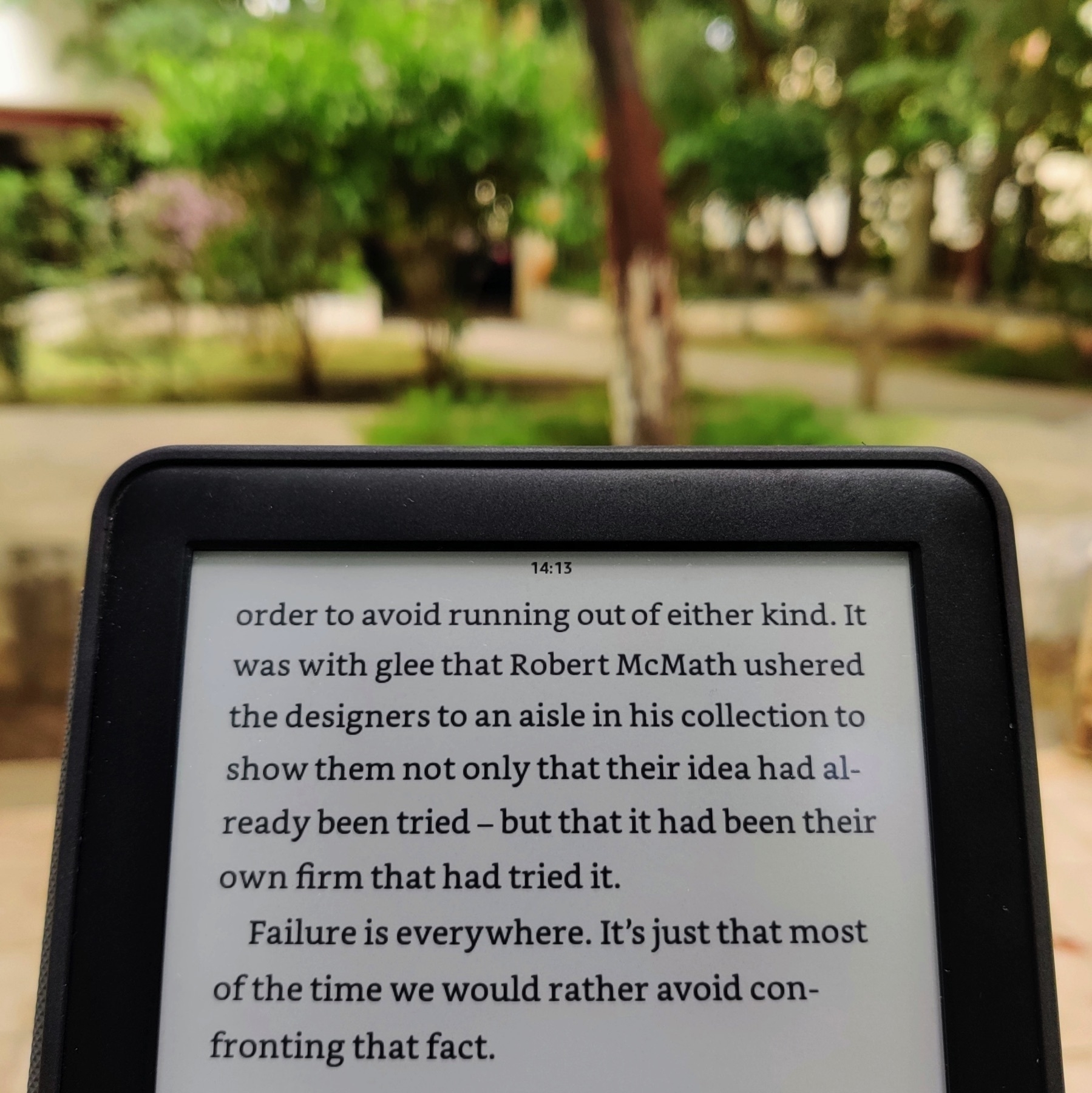
It was gradually that I started rejoicing eBooks. It was via the Kindle app first, mostly on my iPad. The built in dictionary was one of the most useful feature that pulled me in. It helps a lot when a person, not well-versed in English, can simply select a word to fathom its meaning. No need stretching out to fetch a dictionary and scan for the word. Either that or to make some broken sense out of the sentence without knowing the word. Not an experience one can call satisfactory.
There was another feature that I benefitted from the most, sync to the furthest read position. Be it an iPad, iPhone or the Kindle web reader extension, be it home, office or a lengthy queue of a supermarket, my book was always available, synced to where I had left it earlier. There is some relief in not maintaining a physical book and the nosy bookmarks. They are played with, they are misplaced, they are lost. They even are hinderance sometimes, often when you are in-fact reading. (Isn’t that generally a time one holds a book anyway?)
eBooks came handy. But there was still an issue I faced. iPads were heavy, iPhones tiny. Paperbacks (mostly) are best by size and weight. You hold them, read even at a stretch and don’t feel you have lost a limb. With iPads? Well, they really are not made for reading in long stretches. Not at least the iPad 2, which I own. Most of the time is spent in finding the perfect surface for resting the iPad on. Not really a painless experience. Inadvertently, I ended up reading on iPhone more.
Kindles, the hardware, had just recently launched in India. I knew there were benefits to them. For one, they were made with reading as sole purpose. So they were designed to be best fit by size and weight. I had heard so many stories of how it changed people’s reading habits, made them read more. I knew I wanted one. A bit of research, a bit of playing around with them. I decided I wanted one. For reasons of mine (which I would go into someday), I settled on the Kindle, 6″ E Ink Display (Prev. Generation) with page turning keys, the non-touch screen one.
And the reading experience has never been the same again. I am reading more, I am reading longer. Surprisingly, it has made my wife too into an avid reader. A person who rarely considered reading as her hobby, she spends good amount of time finding and reading books. Paperbacks, ones with real pages, could never do that. eBooks did, especially Kindle.
So coming back to a paperback, it did turn out to be a painful experience. Holding the book was troublesome. Bookmarking was troublesome. Turning pages was troublesome. Wanting to read the book at office was worthless. At one point, I wanted to stop reading it in between, buy an ebook version and continue. The nostalgia, induced by the scent of real pages, can only take you so far. eBooks, for me, have ruined the pleasure of the physical books. Kindle has owned me now; and I can never go back.
I started reading this book wanting, assuming, it to be a suspenseful thriller. I was unaware it is more of a sociopathic, twisted whine-fest. Some can call it a character study, narrative of flawed minds. For me, though, it is all whining. Sick. Sorry!
First. You get thrilled only when you long for some character, root for the happenings surrounding their lives. Gone Girl presented none too me. None of the protagonists, neither Nick nor Amy, interested me. They are too twisted for me to care for them. There was a time I wanted them to just get rid of one another.
Second. Plot progresses at unbearable pace. Not slow. “Unbearable”. It is either stagnant when author is flaunting her literary chops, narrating “character study”. Or it progresses to next sub-plot or twist way too conveniently. Nothing is believable here. I could not connect to, sympathise with or even imagine any of the events. Slow, lazy unwinding, I don’t mind. This broken, staggered recital I have problem with.
And then there is the crazy middle and end. [spoiler] When you make me read ~250 pages of whining, only half way into the book, you better not tell me it was all setup. Nothing you read is true.[/spoiler] The end is dragged so much that I was just turning pages to make sure it ends. I just didn’t care how. There is no buildup, there is no climax. It just ends abruptly. Not left open, but left carelessly unresolved.
Sigh. Anyway one can say I should not have read this after all, it is not for me. This dissection of human psyche, especially the twisted one, is not to my taste. All I recall is I have never kept looking at the percentage-read mark so profusely ever. And that’s where Gone Girl failed me.
My rating: 2 of 5 stars
So, I finally watched Interstellar yesterday; after days of, literally, closing ears and eyes on every mention and reference of this word. It is difficult, not to know anything you usually want to know first-hand about. No one else to blame though; I should not leave the decision of ruining a movie or a book to others. That call should stay only with me after experiencing it. This post is about my experience of watching the movie I waited so long for.
Experience, yes. About the movie, no. There are too many intelligent posts already written about it. Reviewing it, explaining it. The plot, the science, everything. This is not a post where I intend to do any of that. This is post where I intend to jot down my thoughts of going through an extravagant experience like Interstellar in India. I want to do this especially given I was watching a movie after a break of more than a year & half. I wanted to see how technical advances have improved, if so, the overall movie going experience.
So here it goes.
Experience of booking a movie has improved since I last did it. Apps have improved a lot. I was pleasantly surprised when the app supported adding the movie ticket to Passbook as an event entry pass. Nice effect and effort of customizing the app to the platform it runs on. Surprisingly, and sadly, not many try to do that.
But using the said pass at the movie theatres is still not possible. I searched for the machine or the person to whom I could flash the pass and enter without a physical ticket. Not possible yet, at least not at all the movie theatres. You still have to collect a physical ticket, show it to a person who tears a part of it & hands over what remains as a proof of your approved presence. They do have a machine to collect the tickets though. However anyone, with the booking id, can print the ticket without any validation. He, then, can flash it further as a valid entry pass. Plus it’s heading read ”Booked by Internet”. Sigh.
Multiplexes continue to ruin the theatre experience in India. The aim to maximize the earnings out of the small retail spaces is punishing the viewers. Each “Screen” has a maximum of 8-10 rows, with each sitting 15-20 folks. That limited is a Screen. In such small spaces, we have 3 tiers of convenience, Silver, Gold and Platinum. Like a regular middle class person, I selected the middle-tier. Surprisingly, the distribution is as any corporate evaluates its employees’ performance. 10% are awesome. 10% suck. All others are regular blokes who are just okiesh. Same was the case here; 1 row of platinum folks and 1 row of silver. In between the 8 rows of fools. Platinum folks sat with their necks held high, not because they paid more. But because they could hardly see what rolled on the screen without doing so. Then I do clearly recall a “silver” person turning around and laughing at the “golden” dummy sitting behind; pointing at his silliness to have paid more. Sigh.
Because “Screen”, the hall, is so small, the actual screen itself is made small. And so very close to the eyes. To be frank, except for the darkness and the silver bloke pointing & laughing at the dummy goldie, this was not that much a different experience than sitting a foot from my LED television at home. Interstellar deserved better. Multiplex are to know that. Sigh.
Every movie is to have an intermission. After all , we believe in giving businesses to many. If there’s no intermission, how are the samosa, pop-corn walas to get their earnings? So a movie is abruptly stopped. Usually I feel every Hollywood movie-maker is aware of this fact; so I could find a logical break being put in every movie. But I think the person who is handed this responsibility uses it to break when he has to pee the most. Be it, then, at the most inopportune place, in middle of some secret revealing dialog. Who cares; he has pee to handle.
People still chatter during the movie. That is after they have settled into their chairs after arriving late. Especially when in a group during a Hollywood flick. More so if the said group is all guys surrounded by another group of girls. Some smarty has to show off his knowledge or crack a foolish, unrelated joke. Happens.Every.Single.Time. I literally watched half the movie with my left ear closed to avoid one such Einstein explaining every single scene that unfolded on the screen.
And then the ‘usualities’. National anthem is still played, with half standing in respect and others poking there noses around. Head-shadows of late comers are still seen. Mobiles are still not on silent mode. Samosas and pop-corns are still money-wise costly and taste-wise cheap. Torch-bearers still enlighten the lost and side-tracked, searching for the seats. Sigh!
Anyway, Interstellar was a great movie; it deserves a better treatment than is accorded. Wish I had chosen a single screen theatre, booked a balcony ticket after standing hours in queue and experienced this marvel on a huge screen listening only to the whistle, and not chatter. Or else simply stayed home, catching it on my LED television. A foot away. Sigh!
Agatha Christie, a name I saw at every bookstore and avoided every single time. The books ‘looked’ short, felt they had to be short stories for pre-teens. How wrong was I, to neglect the suggestion not to judge books by cover, by how they ‘looked’.
And Then There Were None has to one of the finest, sharpest and crispiest whodunit mysteries I have ever read. Everything is perfect, to-the-point; all about the main story and the characters involved. Chapters after chapters, new plot twists are revealed. The story never stagnates. No character eats up the pages. No sub-plots are introduced just to thicken the book binds.
But most importantly, there is no single person that knows-all-but-shows-none. Incidents occur and they are presented with all the details visible to the characters involved. Nothing is hidden, made visible only to the selected one, the detective. Because there is none.
The experience reading this gem is amazing. I pride myself to foresee the final mystery way bit early than it actually is uncovered; or even hinted at. This one bowled me over. Almost all the 10 characters were on my criminal radar at some point. None stayed there for significant time though. Even post the final chapter, I stayed stumped, wondering what has been uncovered. Because, frankly, nothing is. This, indeed, is a novel of a kind.
If you love mysteries and haven’t yet hopped this ride, you must. Agatha Christie says this was the most difficult novel for her to write, she took utmost effort to make sure she pens a perfect, unsolvable murder mystery. All I can say is she did succeed.
My rating: 5 of 5 stars
The novel is an entertaining read overall. Expected given that it is penned by an experienced story weaver. But then it also has those parts that make the experience average, at times.
It starts out promisingly, Strike interested me. So did Robin (sigh!) and their case at hand. Mystery is woven, with the prose heavily studded in the initial part. Studded it felt, given I thoroughly enjoyed reading it. It made me know the characters, though very few, more.The main characters and the plot are built perfectly at about a forth into the book. And then it gets stuck.
The mystery that was revealed stays the same; neither does it become more intriguing nor clearer. Lots and lots of characters get introduced, but hardly any new information is unravelled. It was during this time when the prose, that I had initially relished, became a hinderance to my enjoyment. Especially ones that broke the flow of conversation. So unnecessary they felt, so much so that I skipped some paragraphs.
The plot does pick up towards the final third of the book. Unnecessary prose continue. But this is also when the book becomes unputdownable. So much is revealed, in such intriguing a way. And the plot stays interesting till the end. The climax, unlike so many mystery novels, doesn’t feel dragged. The mystery is unravelled in satisfactory a way; a way I do not usually cherish however.
Yes, I do not cherish the style of suspense novels when we do not have the access to the detective’s thoughts. Style where the key information, or the interpretations, are hidden from the reader only to be revealed at the end. The Cuckoo’s Calling presents Strike this way. Satisfactory, but not preferred.
And that’s where the novel lets me down, unnecessary prose, non-preferred style of revealing suspense and too slow a mid-third. Overall, though, for the way the plot & the characters are introduced and the case closed, this is a one-time read for sure.
My rating: 3 of 5 stars

Ever since I decided to own and host my site, i.e. basically ever since this place has existed, I was planning to write down my reasons and choices for the engines that run this site. Couple of feedbacks finally made me jot down the thoughts.
One thing I was sure about was I did not want to not control any of the knobs of my blog. So I had to go all in.
Deciding on domain name was simpler part; that is once I had given up on all the crazy pseudo-names I wished my blog would have. So I went ahead with my real name. Simple.
To register a domain, there were a lot of options out there. Some were way cheaper but were sucky and known to follow shady-practises. Then there few that were comparatively costly, but simple.
I had heard so much about one such simple, no-nonsense domain registration service, Hover. Few visits to Hover and I decided Hover was the one that fit my high-horse attitude the most. I usually tend to support the service providers with principles. And it always comes at a cost.
So I registered my domain via Hover. The experience was simple and positively uncluttered. I recommend the service. Give it a go. You will be impressed.
I have been blogging for quite some time now and have owned the free blogs at Wordpress.com, blogger, tumblr and even posterous. I even hosted a blog with Wordpress.org. Each had their own benefits and shortcomings.
So I was on a look-out for an option that is simple, lite & powerful and gives me a lot of control with what I can do. Enter Ghost.
Ghost is a simple open source blogging platform that you can completely own. It provides simple writing tools. I have already detailed what I like about Ghost in the first post here. Even the community has accepted it, so there are a lot of customisation options available too.
Plus if you like coding even a bit, there is nothing better. I had my Ghost blog running on my local machine and I was satisfied, only after some customisation i.e. I adopted and adapted the Vapor theme from Seth Lilly.
All that remained was to make it available on the internet.
Final call I had to make was about how to host the blog I had running on my local machine. One thing I did not want to do was go with a PaaS solution; basically the solutions that provide you just the platform where you can upload the blog and you are up.
In a way, Ghost made my decision to go against PaaS easier. There are hardly such services that support node.js, javascript based platform, on which Ghost is built.
I had decided to either go all in, i.e. get a virtual server (VPS) or simply not worry about hosting myself.
Ghost allows you both the options. You can either go pro with Ghost and let the team handle the hosting for you, like wordpress.com. Second options is to go free and host it yourself. I knew I wanted to go with the second option. And I did.
For getting VPS, I just had two options shortlisted, Linode or Digital Ocean. Linode was costlier. A more pro-dev friendly. Not something I was ready to sign up for with such simple requirements as mine.
On the other hand I had earlier experience, mostly positive, with Digital Ocean. Plus it had Ghost application pre-built.
So it was really as simple as creating a droplet and I had my blog up. Finally, I also wanted to secure up the Linux node, and an amazing article from Feross Aboukhadijeh got me rolling. It is written for a Linode node; but it can very well work for any Linux server out there. Do not forget to follow these steps. They are must if you are to keep the node running even for short time.
So a day in and I had a secure Linux VPS node running my blog which was completely customised by me, as per my needs. And it was satisfactory experience and a fruitful journey.
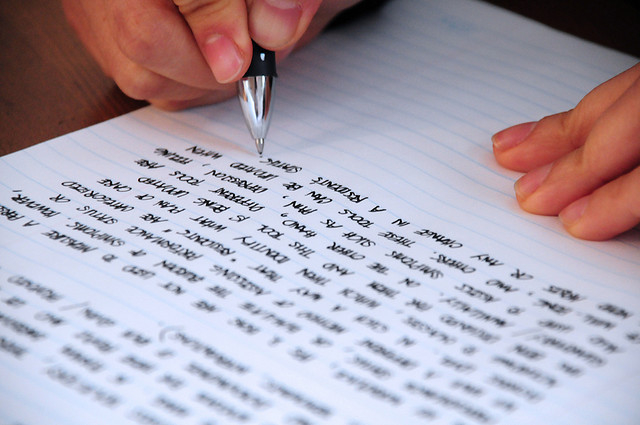
One way to think of writing is to jot down abundance of words, leading towards a story or an account. Another way is to simply think of it as a medium to express oneself. Every person often comes across such occasions to put his thought, his ideas, his expressions in words. Occasions are aplenty. Event in his own life. Event in the lives of acquaintances, friends or near & dear ones. Or just a public event.
One of my friends had a similar occasion, one close to his heart. It was anniversary of his engagement with his fiancé, their's 1st. He took all the pains to decide on the gift, the place to buy it from, flowers to go with it and the time they to be delivered at.
And then he did what I see people doing most often these days. He went to google and typed “1st anniversary wishes/messages”. I wondered why did he not simply scribble what he felt?
It’s saddening to see people resist the efforts to pen the words they think of. They go after what others have written, beautifully never-the-less, but at the cost of it being not real, fake. They underestimate the power of conveying ones own feelings in whichever way possible. The words, their structure won’t matter much then. And that is one way one can start writing.
To start with, don’t miss a chance to write to your loved ones, breed a will to do so. Wish them for their successes/failures. Appreciate their kind acts. Console them for what they have lost. Keep it simple, write the words you feel. Take effort to make it personal. Involving.
Next go for an outline that you feel would be more effective. Decide what is the best way to put your thoughts through. Try and improvise on different ways you could communicate. Do you want to narrate an incident you people were involved in? Do you want to glance with them at the journey you had together? Do you want to reflect upon their qualities, good or bad? Or do you simply want to tell them what they mean to you? Think how best you can convey what you want to convey.
And you would be surprised to see the effect that has; on both the reader and you as writer. Don’t act amazed if you want to open up, to express yourself more. Have belief in yourself and try to write more. Do so even on more public forums, about public issues.
Only difference is, in public, the reader might not be the one you can personally connect to. Write for yourself first. Write what you would like reading, something that will please you.
So if there is one person, you, who you could please with what you wrote, chances are there will be few more. There will always be a group of readers with whom the thoughts you feel would connect. Adornment of affulent words is no longer a need then.
And by the way, everything in life is writable about if you have the outgoing guts to do it, and the imagination to improvise. The worst enemy to creativity is self-doubt.
-Sylvia Plath
So next time you get an occasion to wish someone, don’t doubt yourself. Start writing. Express.
[Postscript] I had originally written and published this post on Medium. That was before I started writing on my self-owned blog.
It is raining outside, a steady fall of cheerful drops. I look outside, while am gathering my thoughts, again. Rains always make me do that. Especially such.
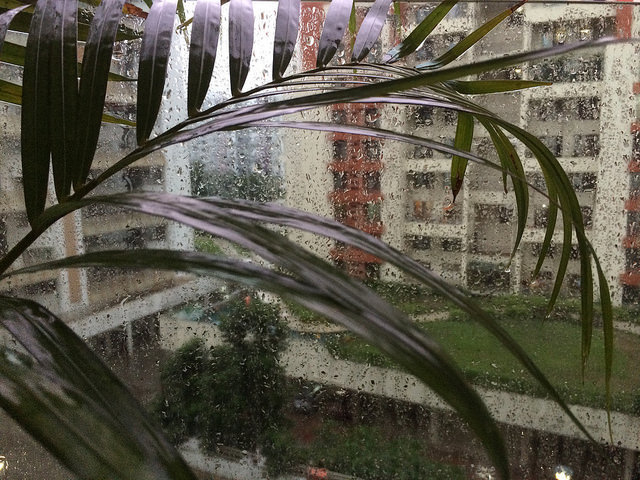
Cheerful the droplets sound, together. This sound beat is no less than a pleasant sufi composition to my ears. It always cheers me up. It is doing the same to me now too. It's affecting the plans I have for the evening. But I do not feel saddened. Plans can be remade. Such rains are rare.
I adore such rains that have a knack of showmanship. They lead with a thorough built-up.
Elaborate gathering of the hazy clouds in the sky. Gradual darkening of the surroundings. Disjointed, but equally systematic, flashes of lightenings filling the skies. Followed so aptly by a symphony of angered rumbles. Unhurried arrival of tiny droplets. And the final showdown with the downpour. Show doesn't end. Post-climactic spans of the gleeful nature leaves one mesmerised.
Today's is one such showman. It, indeed, has left me mesmerised. Rejuvenated!
I like listening to podcasts and have been regularly doing so. Podcasts have almost become my go-to source of entertainment during my commutes or non-working lone times. If I can focus on what's playing, I listen to podcasts. Music is only for the times when I don't want people to disturb me and concentrate, mostly during work.
It's no surprise, then, that the podcast-listening applications, or podcatchers, are few of the most used, and so most important, apps on my phone. And because I interact with these apps very frequently throughout the day, I look for a frictionless experience while using them.
When Marco Arment launched Overcast I was highly excited. I was waiting for this app since he first wrote about it. I knew Marco would have a different take on how we consume podcasts. I had high expectations while I downloaded the app.
And Overcast did deliver. Almost.
Overcast gives a different spin to almost every aspect of the podcast listening experience. Just the first impression promoted the app to my home screen, even my dock. There were so many things that impressed me.
Overall look, user interface and experience of the app has a refreshing feel to it; even the colours and fonts used are easy on eyes. Playlists management and playback controls are simple and intuitive, equally powerful at the same time. Voice boost does assist in making podcasts more audible in a car/bus.
Smart-speed, the silence killer, is brilliant. It's just been 20 days since I started using this app and this feature has already saved an extra 3 hours on my podcast listening time. This feature alone is sufficient enough to make Overcast my default app. It even did for 2 weeks.
However this smart feature was clouded by the data-unfriendly behaviour of the app while downloading episodes. And this was a huge minus for the app.
I feel most of the shortcomings during downloads are due to the misguided assumption on Marco's part; that a user either wants every episode from a podcast automatically downloaded or wants none. The belief, it seems, is one would never decide whether to download an episode, manually, only when it arrives.
Well, that is not true for all. Some of us do like to be notified when an episode of our favourite podcast is released, read what would be discussed and then decide whether to download it or not.
Overcast struggles to do either of it.
You can either "Subscribe to All New Episodes" of a podcast and be notified/not notified when a new episode is released or just disable the subscribe option. There is no way to just be notified, but not download the episode.
Reading about an episode is not easy too. I assumed initially, and accidentally do so even now, that clicking on the episode should expand its description. Rather it starts downloading it. I have to target the (i) and click it to read the description. Not friendly, really.
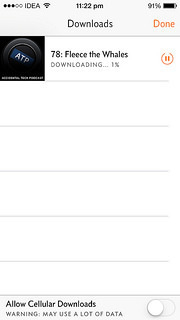
Even when the download begins, the options visible to take actions are not really intuitive. First of all, there is no information on the data size of the episode. It is especially important to display this information when one has to decide whether to download it over the data connection or not.
Anyway once the download begins, the button changes to something with a pause symbol in it. First of all, as can be seen, the ring around the pause button is no indication of the download status.
Secondly, the pause button does not actually pause the download. It stops it, discarding the already downloaded data and begins re-download from 0% on 'resume'. I understand the limitation that Core Audio puts while storing partially downloaded files, but least I expect is not to show a pause button at all if it does not.
All these issues with download manager really make it difficult for me to use Overcast. Marco does say he builds apps which cater to him first and solves the problem he faces. So he, may be, did not foresee the way the podcasts are actually consumed, especially in non-first world countries.
He, also, may say that Overcast is not for me and I should try the other independent apps he, so earnestly, showcases in the settings menu.
However I really like Overcast's episode management and playback features and would want to use them. I would miss them in the other apps.
But as long as the app does not value the importance of data, I am afraid it will stay in my backup folder, waiting for the appropriate update.
One's subconscious wakes up pretty frequently, at times during events not that significant in grand scheme of things. This was one such incident.
It was raining outside. I was, however, in a rush to come out of the building. I had already gotten late to leave my desk. Not that I had a bus to catch; rather I had buses to miss. I had to hit the road before the swarm of office shuttles poured on to the roads. That was my best, may be the only, chance to reach home unflustered.
I was trotting along the road, with my mind preoccupied with the thought to reach the parking lot sooner. Shall I take a straight route to the parking lot with just a turn or one with many arcs and twists? I had already started hustling on the straight route.
I, then, felt an itch on my left hand, just beneath the watch I was wearing.
I removed the watch and held it. I was lost for a moment, looking for a replacement place for the watch to reside. I realised I could wear it on my right wrist too and I went ahead to strap it there.
But my subconscious mind, fast asleep till then, woke up making me aware about what I was doing. That is when it dawned on me.
I never wear a watch on my right hand. Never.
The incident got me thinking why was it so? Why was it that strapping a watch on the right hand was such a taboo for me? When did I decide it should always be on the left hand? I looked around me, none of the people had the watch on their right hand. None. No one.
I could come up with some quick answers as to why that might be the case. But I was not after a particular, rational, answer. I was curious about the pre-programmed behaviour of mine that makes me do, without much thinking, many of the chores I regularly do.
I knew there would be a lot of such wired decisions I keep making, and I went on to identify some of those. It didn't take much time for me to compile the list.
The alternatives just don't feel right to me. Rather I do not even think about or look out for the alternative.
I might assign reasons, possibly scientific too, to each one of them. But I would go back to doing the things, liking them or hating them, just the way I am programmed to do.
And I feel every one of us, if he or she decides, could come up with one such list. All we need to do is keep our mind open and question.
One might wonder what would he/she gain from the exercise? Well, it is good to know the always-awake, the conscious, subconscious is looking over, making small decisions for you, always.
I would no longer be posting on this weblog going ahead. I have finally managed to own my presence on web completely, again. I knew this was a placeholder for my thoughts till I put together a planned-to-be-permanent place which could be controlled by me. I managed to get that done finally, read my views here.
I have already started writing at the new portal which I have simply named as {amit gawande} as finally that is what it is going to be, a portal just about me. If you have liked my writing, I assure you, you will continue to like it going ahead too. Subscribe to the new rss feed.
This site is a result of in-numerous attempts at pushing myself to own my blog, again.
My last attempt was significant for me because it allowed me to fully host and own a wordpress blog. It had a good run through my bachelor life, got neglected later and finally shuttered, post marriage. Posts still reside, though, at a wordpress.com blog, which, deep inside I knew, was nothing but a placeholder.
So my wait continued for the inspiration that would push me to create and own, again, a simpler place for my thoughts. And that inspiration came from Camel, the blogging engine from Casey Liss of atp fame.
The inspiration, though, was not because I liked Camel, which even now I haven't made my mind about. But it was because I wanted to have something as simple as what Casey had, and get that done in an equally simpler way. At the same time, I also wanted to learn and try something new.
I knew my requirements were not complex, neither did I expect my audience to be huge. So I needed something simpler than a full fledged, php-rich, wordpress blog hosted on a dedicated host, which I also realised is too costly for my needs. Enter Ghost!
So this is where my quest led me to, a simple Ghost based blog to jot my thoughts down. The reasons, I had my own.
Simple I had heard so much about Markdown before. I felt everybody, almost everyone who writes for himself, was using Markdown. And every one of them had all the nice things to say about it. Even I tried learning it numerous times. But, I realised now that it is only when you use it that you appreciate the simplicity of it. It really makes writing, just about writing. Something I really needed.
New I wanted to change everything, the way I write my posts, the way it looks, the way it works and the way I would host. I was bored of all that wordpress or even tumblr, something I played with for sometime, provided. It all felt the same. For some time, I even thought about just using Camel. But then I would have had to work even on the engine along with writing, which I didn't want to sign up for just yet.
Not costly For hosting, I wanted to meet the above 2 points first, at the same time consider the cost factor. A free option existed with Heroko as suggested by Casey and Greg Bergé. However, I either wanted to go all in, with hosting on VPS or just stick to the simplest option from the creators of Ghost. Anything I chose, would have turned out to be a lot cheaper than what I paid for hosting the unnecessarily complex wordpress blog.
What I, thus, have is a simple, minimalist place for me to just write. I own, again, a self-built, self-hosted blog. Here's to another start!
[Postscript] There would a temporary phase when I focus more on the place than on writing. However, I intend to cross that phase pretty soon. Whatever that results in, I feel, should, more or less, look pretty similar to this.
[Postscript 2] I have writen a followup post that explains the whys and how-tos of this complete process.