I loved the recent article from Dan Lewis about the history of the word “curfew” and how it took the meaning that it has today. It’s fascinating how words change meaning over time as the world changes. This story is no different.
With a lack of any options for a minimalist phone in India, I am glad that Android allows custom launchers. I have stripped most distractions off my phone with one such option. I’ve managed to kill the subconscious “swipe-tap-launch” cycle for sure.
iPadOS, specifically its multi-tasking, must be Apple’s Achilles' heel in making the iPad the default family computer. They attempt to improve its windowing capabilities significantly every iteration, only to further muddle it. What’s a Computer? It for sure is not an iPad yet.
And it begins - T20 #cricket worldcup is on the role. There’s been an exciting build up to this match. Yay! 🏏
It is for conversations like this that I love browsing through the Micro.blog timeline. The only place online where I feel am amongst my friends. Thank you, you lovely folks! 😇
Numerous world changing ideas are drained down during the shower, killed by the lack of any tool to capture them with.
Don’t know why, but I am psyched about this year’s T20 #Cricket WorldCup. I don’t fancy the Indian team’s chances - their form has been patchy. Yet I feel this WorldCup will be exciting.
Never listen to the person in you who has just woken up in the morning. He gives the worst advice. The only one he does give for that matter is, “Go back to sleep buddy”.
Just close your ears and run out of your bed.
When cleaning the home is not a chore but a family activity. There’s loads of shopping. Sizzling in the kitchen throughout the day. A sense of excitement, of inexplicable urgency. Diwali vibes are here!


Since I moved microblogging to my blog, I have always focused on getting the look of the short posts right. I didn’t want them to be lost amidst the prominent titled posts. Nor did I like it the other way around. That meant I never had either looking how I wanted them. Well, that’s not the case anymore.
After a long time, I am finally happy with how my long-form articles and short-form notes sit distinctly together. The setup took time and some crazy personalization, but I had to shake a few things just for the sake of it. I had started taking my blogging too seriously, and I didn’t like that. I work better when it’s fun.
The only downside is that it is an entirely custom and personalized theme. And for now, I am okay with that. Plus, it’s still a work in progress.
When a shade of green is glitzed up by the shadows. Just another game the light, or the lack thereof, plays.

Being Favourite vs Being Popular
Every service wants to be everyone’s favourite. But what the makers are working towards is being favoured. Or popular. There is a minute but significant distinction between those two.
It is easy to market something subjective, which is what the latter is. “Best…”. “Most liked…”. “Hottest…”. How often do we hear those words in advertisements? The former, on the other hand, is binary. Objective. You are either someone’s favourite, or you are not. More often than not, people won’t know what their favourite something is. Ask someone for their favourite movie or a book, and she can’t put her finger on one.
Being a favourite is also singular. What point is being just one person’s favourite? You can’t market that. Of course, as long as the someone in question is not famous.
I wonder if seeking to be someone’s favourite is more satisfying than trying to be popular to everyone.
Seth Godin made this observation in one of his latest posts. Well, it’s not about satisfaction but the ease of selling.
I have never had the dark mode turned off since the option was made available on my devices. I did today. After an initial bout of pain, things don’t look too bad. Instead, they look cleaner. The whole experience - the platform, the apps, the websites - is so very different.
One thing is pretty apparent - all the interfaces look better in the light mode. As if the apps are designed for the light mode first. The setting, the interface elements, and the colour palette look ingrained. With the dark mode, all apps look the same – white text on limited shades of dark background. Maybe that is the reason many people prefer this mode. Irrespective of the app, it looks the same.
I don’t mind a diverse collection of interfaces. So against the wishes of the techie in me, I will extend this experiment for a bit longer on my smartphone. I will use it with the dark mode turned off. It can’t be too bad, right?
I love the Remarkable tablet, from what I read – pity that it isn’t available in India. With Amazon being more open towards the Indian market, I am excited about Scribe. But chances are high that it would be locked into the Amazon ecosystem.
Having More Choices is Dreadful
Choices are abundant these days - more variety of cuisines, more brands of clothes, more range of devices, more solutions. More of the same, yet different in imperceivable ways. More is good, right?
Not when the dread of choosing paralyses me. Making a selection demands brain cycles, both while and after choosing. It needs time from you. If there is real money involved, the process is even more demanding. Fear of regret kicks in then.
Is the other one better? Cheaper? Would I hate this later? Will my family hate me for choosing this? Will this improve my life? Each question is more complex than the previous one.
In the false hope of “saving” time and money, I postpone choosing. My unmade decisions pile up, and so does the burden on me. It is a vicious cycle – I delay choosing because I feel vague pressure, a choice that only adds to my burden.
Not choosing is a choice too. Make it your default, and it will only make you weaker.
I’ve pushed an upgrade v1.0.1 for Anatole theme today – it fixes a few minor issues with the categories on the archive page & images on smaller screens. The theme now also supports mastodon profile in the social links list. The upgrade is available in the plugins directory now.
Anatole – A Two-column Theme for Micro.blog
Ever since I published the Paper theme to Micro.blog, I wanted to port one with multiple columns and yet stay minimal as possible. I’ve found one, and today I managed to port it to and customize it for Micro.blog. The theme, called Anatole, is a beautiful minimalist two-column theme. You can check for yourself in the screenshot below or see it live on my test blog.
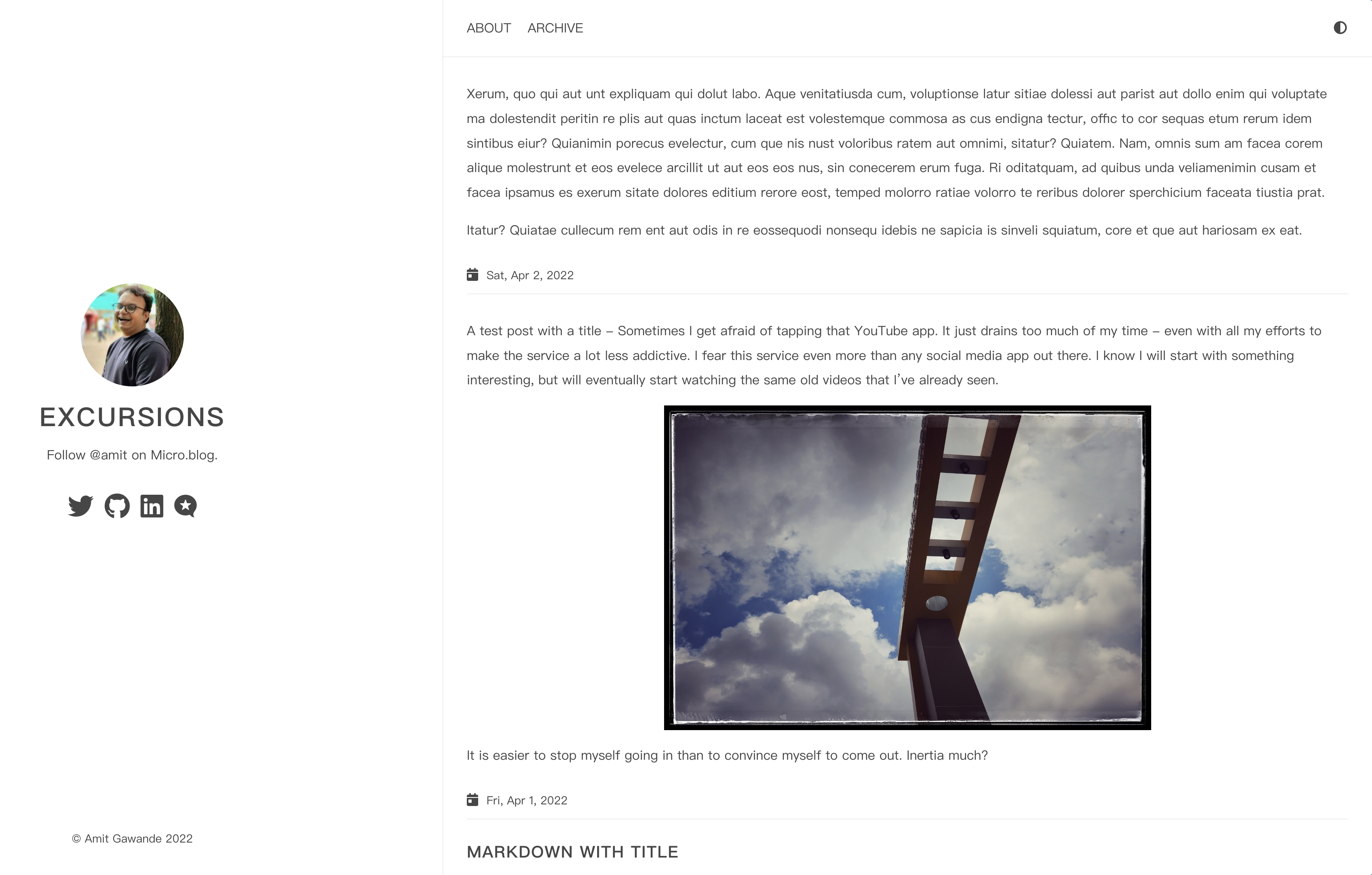
The theme is available in Micro.blog’s Plug-ins directory and can directly be installed from there. Note that the theme is compatible with Hugo 0.91, which is available as a setting on Micro.blog. You can follow the below general steps to install the theme.
- Uninstall any theme that you have installed as a plugin.
- Set your current theme to blank and Hugo Version to 0.91 in the design section of your blog.
- Make sure there are no other conflicting custom CSS configured for the previous theme.
- Install the “Anatole theme” plug-in from the directory.
- Once the theme is successfully installed, you can configure the social icons displayed in the header by modifying the available options as plug-in settings.
- Additionally, you can configure parameters to display full post content on the homepage, disable animations and provide a path to a custom favicon.
It was fun to bring another option to Micro.blog’s already brilliant collection themes. I hope you like this and that a few folks benefit from it. If you do, I would love to hear from you. All feedback is welcome.
I watched The Adam Project today. It’s such lazy movie - it had all the ingredients to be a brilliant movie. It’s good fun in parts, has some nice moments. But makers were lazy to not be interested in making it any better, enough was enough.
After returning to Safari from Arc, I realized how pathetic the experience with this default browser is. It looks dated, is slow, and has terrible interface choices (tabs bar, bookmarks, home page and on & on). I tried Chrome, too, and it is ridden with bugs. So I’m back to Arc.
A Day in the Life in Pune, India. A stairway to the blue skies on the other side.
Every afternoon for the past few days, the clouds crowd the skies as I wait to pickup my daughter from the school. They didn’t disappoint even today.
14 October 2022, 3:30 PM

I Love Technology
Whenever I pick up a call on my watch and talk to my wife, I am happy.
Whenever I scan or tap my phone to pay for stuff, I am happy.
Whenever I click a button on my smartphone to capture the best of the moment in front of me, I am happy.
Whenever I beam my voice to my daughter in another room as if I am next to her, I am happy.
Whenever my lights and plugs switch off on schedule or on my command, I am happy.
Whenever I push a photo or video from my phone onto a larger screen for my family to enjoy, I am happy.
Whenever I watch my dad live as he excitingly shows me a new shirt or a new faucet, I am happy.
I am happy when my phone guides me around a place, known or unknown. Alerts me of road closures or diversions. Reads the text in front of me. Or helps me with my quick queries or requests.
The list goes on.
And I am only talking about the capabilities of the devices on me. I am surrounded by technology that brings a smile to my face every day throughout the day.
I can be frustrated by the things these gadgets cannot do well (or can’t do at all). Or I can be angry with them when they alter my habits against my will.
But just as the technology is at fault for not acting responsibly, so am I for not using it sensibly. When I wish the technology to alter itself to not burden me, I share the responsibility to find ways to not be controlled by it.
Do I have enough levers? That’s debatable. What isn’t, though, is my love for technology.
I love this view everytime I visit the place. Looks so far out, but I usually just driven past them. Can never get enough.

iPod died, and so did my habits with music
I hate Apple for killing the iPod, as they took down the whole MP3 players industry with it. Sure, the rise and popularity of streaming services have played a hand too. But irrespective, my music listening habits have changed tremendously since. So is the iPod's death a cause or an effect of my dwindling love for MP3s? Like most things post-internet, it is both.
Steve announced the product with a brilliant marketing tagline of 1000 songs in your pocket. Unfortunately or fortunately, it also meant only 1000 songs in your pocket. With my first internship stipend, I purchased an iPod shuffle and fell in love with the device. I carefully selected a few songs I could listen to on a loop. Or day-in-day-out. I built my playlists for the different moods. I subconsciously memorised each of those few songs — the first tune, or the few beats, were enough for me to start crooning along.
My love for owning music goes way back to the pre-iPod days, though. At first, it was with my Sony walkman and the few cassettes that I built a liking for. Even when the computers came, I created a collection of music that I was incredibly proud of. For my friends, I was the guy to visit when they needed a song, new or old. Or when they needed to find the one song which they could remember only vaguely. We sang those songs for hours. In our rooms, in classrooms, in corridors and on trains. We built a liking for the few songs as we made listening to them a habit, a hobby.
That is not the case anymore.
With streaming services like Spotify and Apple Music, I now have all the songs I need in my pocket. And yet the experience has slowly grown hollow. These days, I put on the music more as background static than the immersed escapade that it earlier was. My mood doesn't decide the music I listen to. Some curator on Spotify does so. This thought in a recent Guardian article resonated with me.
Streaming makes the listening experience much more passive. (…) This idea that you can just turn on a faucet, and out comes music. It’s something that leaves everyone to take it for granted.
Passive consumption is not suitable for any form of art — music is an art of the most extraordinary form. Listening to music was a hobby once. People listened to music as an involved activity -- not a medium, to put them in a focused mood while they do something else. Or to mute the background noise. You don't say, "I am reading a book", when you skim through the pages only to fall asleep, do you?
I am reminded of my changed habits whenever I see my daughter enjoy her music. She has a set of some 50 songs which she listens to every day. She plays the same songs even on streaming services. She selectively adds a song to the list and does so only after she has listened to it enough. Just like the pre-internet me, she embraces her music – the first 2 seconds of a song are enough for her to start singing along aloud. Not just the lyrics but even every tune.
Sure, I could still fall back to my music-listening style of yesteryears with my smartphone. But the "smartness" of the device already hinders any semblance of focus that the one-purpose iPod allowed. I also understand that there are a lot of positives to streaming services. The discovery of new music and artist is one big plus. But what is a discovery worth if I don't feel the emotion behind it?
This is one of the major obstacles to practicing mindfulness with any regularity: you need to be interested in experience in order to observe it, but how do you sustain an interest in the mundane stuff of life, when it’s mundane by definition?