
Excursions avatar

Essays

Book Review: A Man Called Ove

Very few books make me root for the central character. Ove has me hooked.. am with him for a fun ride!” That was my update a third into the book. And boy, did this guy keep me hooked. I was with him as his past unfolded in front of me. I was with him as his present life was amended by some funny, some happy, some sad events. Above all, I was with him as this grumpy old sod grew into a grumpy, but caring, grandad.

Author, Fredrik Backman, allows the characters to grow and that is the biggest reason the book worked for me. There is no haste in revealing the past or bumping into Ove’s future. Every chapter, a short story in itself, unfolds more of Ove and the world around him. You see Ove as he is. You are slowly led to understand why he is the way he is, mostly via flashbacks. You are made to feel for the guy, made to root for him to not stay how he is. And when that happens, because you are already absorbed into Ove’s life, you are left contented.

Saying Ove is grumpy would be an understatement. He is on the edge always, ready to get worked up. He is disappointed in everyone around him. He feels no one is responsible enough to care for oneself - dependent on others for every little thing. He feels the world around has no respect for rules of the land, doesn’t matter they are chalked out by Ove himself. So he takes it upon himself to make sure people are constantly reminded of that. And that’s how he lives his life - a monotonous, misanthropic one . And as Ove is planning to end his troubles with his life, fate has just the opposite planned for him — to add just enough goodness in Ove’s life to thaw the bitterness.

The book maintains a wry sense of humor throughout. It made me laugh out loud at multiple instances. Especially, the way Ove’s frustrations in other people’s incompetence are worded is an absolute masterclass. The book also maintains a deep sad undertone. It does not ever let Ove’s sulkiness make you hate him.

So be it through his affection towards a young boy in love or forced, but welcome attachment from the lively new neighbor or the unspoken responsibility towards the old, and may be the only friend, Ove always shows just enough warmth to make him the most likable character in a long long time. Or in Sonja, Ove’s wife’s words, the strangest superhero I have ever heard about.

Go welcome this guy, and the gang, into your life. He will make you smile, guffaw, shed a tear and, above all, enlighten you towards life. A must read.

My Rating: 5 of 5 Stars
A Walk to Remember

It was pitch dark across the town of Diu. The street winding down was deserted as usual. It had recently been washed off its weariness by the unseasonal rain. In a way, it was a perfect setting for one pleasant, romantic walk.

A couple silhouetted against the discontinuous bouts of illumination from the lighthouse nearby. But their walk was no way romantic, may be a tad tipsy rather.

Roy and Joel had been walking down the street for almost an hour. Yet their individual opinions were divided. Joel thought it must have been four hours. Roy, however, opined that he was off by at least 3 hours and 30 minutes.

No way” bawled Joel, We must be just debating this for last 2 hours.”

Again, you are off by an hour and 30 minutes at the least” Roy countered.

How are you so sure? It’s as if you want to stay here longer.”

Of course, I do. Don’t you?”

Well, not in the shape I am now” Joel hit back with his fiery eyes. Anyway, shouldn’t we be searching for what we are supposed to search?”

That is exactly what I am doing” replied Roy, peeking at the byroad they were passing by.

I don’t think we are searching for the same thing, though. If that were the case, you would be peeping minutely down the manholes. Not glancing at the lanes as we pass by.”

Roy just smiled.


Ganu saw the two bodies tottering along. He wasn’t sure if it was their walk or his drunk vision that was unsteady.

One was looking minutely at the footpaths, and in the garbage bins, and over the plant pots. He thought he also saw him once peeping inside a manhole. He was for sure searching for something.

The other, the skinny one, was not searching for any thing, though. He might well be searching for someone. thought Ganu.

There was something about these two people that appeared odd to Ganu. They looked unconventionally fresh for the time of the day, the season of the year, and the condition of the city. All were in shambles.

Ganu did not like such clean people. He felt no one should be this clean when he was drowning in his sorrows.

Ganu started following them.


I think that guy there is following us. Is it ok if he sees us?” asked Joel, in a worried tone.

How would I know? I too am going through this for the first time. I, anyway, do not think anyone ever has faced this. I think even he would not know.”

Of course, he would know. He is the one who sets the rules.”

Roy shushed Joel as he heard the muffled voices, the wailings. He walked towards the next alley — there was a gathering of saddened souls.

Roy just smiled, again.


Ganu walked behind them to the crowd and steered himself towards the middle. He saw the back of the skinny one now, looking down at a weeping woman. And just as he saw what lay unmoving on the ground in front of her, he collapsed with his eyes wide open.


Oh, crap!” exclaimed Death. Now this hasn’t happened ever.”

He looked at Roy, Joel, and the other souls. Well people, the only way in now is down. Let’s go search for that key to the heavens.”

Pinboard & IFTTT

Maciej Cegłowski rants on how IFTTT pulled the plug and dropped the support for Pinboard.

Imagine if your sewer pipe started demanding that you make major changes in your diet.

Now imagine that it got a lawyer and started asking you to sign things.

You would feel surprised.

This is the position I find myself in today with IFTTT

This has to be one of the best break-up lines ever used. There is a bit of disdain for IFTTT in Maciej’s tone, but his anger is justified. When your whole business is driven by the content that exists at other freestanding services, you do not govern the terms the said services should operate in.

Maciej has already levied against IFTTT, or as he defines it, the Internet plumbing that has been connecting” web services - recommending alternative services to his users. I, for one, am going to continue with IFTTT. I know they have put a misstep, but am hopeful they will learn from it.

Update: Armin Ronacher has perfectly captured why I feel it is a misstep from IFTTT in his tweet.

Idea of The Daily Message

Ev Williams suggesting an idea for a new age messaging app to overcome the rush of frantic messaging.

A messaging service/app that only delivers once per day (say, noon). It’s like going to the mailbox and seeing what’s there for you.

It's an interesting idea in principle. But it would not work in reality. Here are my few quick thoughts.

Why Not!

I think it would be interesting to follow the positive effects of this "forced limitation" — things that might make this experiment succeed.

  • Writing might be fun because people would have time to mature the thought, an idea and word them in exactly the format they want them in.
  • Reading might be fun because there is no urgency to stay on top of the current happenings. Messages don’t become stale if not consumed and commented on as the event is happening.
  • What a person writes about and how he words them would be anticipated. Patience is a virtue that is dying a slow death amongst the people socially active today. If forced, it might allow to pull the reins back a tad.

Why Not.

However the limitations would force the user to see the not-so-good side of the social interaction.

  • Both for writers and readers, the urgency of publishing and consuming would shift from the time of event to the time of publication.
  • The message delivery time cannot be decided to be a fixed time for all — a sort of broadcasting duration. Because not every person has the same consumption pattern. They vary a lot, making the delivery time further complex.
  • The behavior is very similar to a daily/weekly news digest. Anticipation lasts in the initial phases, wades out slowly as the unread messages mount up. Rather, the dying patience makes this experiment further difficult to succeed.

Forced limitation is the stick, but where’s the carrot?

Why Gender Equality is important for men too

Emma Watson gave an impassioned and effective speech at the U.N. headquarters in New York. The address was as part of the launch of HeForShe” campaign.

Overall speech from the U.N. Women Goodwill Ambassador is a must watch — not only for the fact that it was highly applauded & admired, but for a fresh view towards Feminism.

I was especially gratified to hear her speak on why gender equality is an issue, and a cause of concern, for men too.

Gender equality is your issue too. Because to-date, I have seen my father’s role as a parent being valued less by the society — despite my needing his presence as a child as much as my mother’s. I’ve seen men suffering from mental illness unable to ask for help for fear it will make them less of man.(…) I have seen men made fragile and insecure by distorted sense of what constitutes male success.

Men don’t have the benefits of equality either. We don’t talk often about men being imprisoned by gender stereotypes. But they are. And when they are free, things will change for women as a natural consequence.

If men don’t have to be aggressive in order to be accepted, women won’t feel compelled to be submissive. If men don’t have to control, women won’t have to be controlled. Both men and women should feel free to be sensitive. Both men and women should feel free to be strong.

It is time we all perceive gender on a spectrum instead of two sets of opposing ideals. If we stop defining each other by what we are not and start defining ourselves by who we are, we can all be freer.

Complex topics are rarely worded more succinctly. Respect for Emma Watson and empathy for the gender equality fight has risen manifolds in my mind.

Do watch the complete video and contemplate.

Book Review: The Oath of the Vayuputras

Typical Trilogy. Starts well. Goes haywire. Falls flat.

Such a letdown by the finale. Last third of the book completely ruined the build-up — which itself wasn’t too great. But this could have been so much better if the author did not fall for the pressure to jack up the number of pages — the effort, to stretch the story unnecessarily, clearly shows.

It’s all about the impending war. Amish can write battles well. But he struggled to put the battles together into an interesting story. Towards the end it was just a drag. There was no thrill, there was no surprise, there was no story remaining. It was just an attempt to conclude the trilogy, a miserable attempt at best.

There are too many characters, each seeking a closure of his own - leading to too many unnecessary side stories. Further surprising is no character behaves the way you expect them to behave. Parvateshwar doesn’t. _Ganesh_doesn’t. Even Shiva doesn’t - the biggest issue.

Sigh. It is not easy to close mystery trilogies. And the frustration at not being clear on how to do so, for Shiva, shows from the plot that unravels — left me fuming.


Spoilers Ahead

A side note on the overall series, I am completely baffled by how the tile & summary of the novels set complete different expectations than what the actual plot delivers. It applies for all 3 — realised first with The Secret of Nagas”.

There was no secret of or from Nagas that was significant to earn a title. This one goes further ahead. At least in the second one, Nagas had significant role. Here, Vayuputras just have no f-ing role at all. It could very well have been some smart brahmin who owned the nuclear” weapon and it would not have mattered a whit. And Oath? Which f-ing oath are you talking about? Plot goes on irrespective of it exists or not. In fact, one Shiva gives Mithra, he so uncharacteristically breaks.

Sigh! Every word in summary is to hype up the mystery. Titles are completely baseless. Not the right precedent this.

My rating: 2 of 5 stars

Book Review: Mort

A great fun read with extremely witty subplots is how I remember this book. But then I think about it a bit and it is not how I felt throughout.

It is extremely slow, occasionally (just) funny in the initial half. It does have that moment of laugh-out-loud humour in between — but slow nonetheless. So much so that I had lost the interest in between. It was as if jokes were written around characters (mostly caricatures) and thrown in. And the pages filled in describing the fantasy land and the surroundings were too much at times. But that is before the plot picks up and fun kicks in again.

The novel is sheer pleasure after that. I couldn’t put it down and wanted to know what happens next. Frankly, more than what happens, I was interested in how Terry Pratchett words it. I have realised that Pratchett is a master of witty fantasies. It was not that rare when I used to pause and admire how unnaturally a feeling (like fear, anger , etc.) can be described without sounding stupid. If there ever was a university of metaphors, Pratchett would surely be the founder of that. And he would still be teaching a course on thinking big — weird, but big.

So here I am confounded for the first time after reading a book. Do I like the book, the story or do I like the way it is often spun? And it turns out I find the book to be just OK. But then I would pick it up any day, go back to my highlighted passages and admire the mastery at work.

And just for this master Pratchett, I will pick up another of the Discworld novels soon and start taking notes.

My rating: 3 of 5 stars

The Ads Dilemma

Every time I read an article online that grabs by attention and interest, I am faced with a dilemma. I feel am gaining something without compensating for what is due to the writer or/and the owner of the website.

I run Ads-block extension. Well, the web publishers are themselves to blame. Look at the following tweet from me and I hope you feel the pain (i.e. if you do not, already).

[twitter.com/_am1t/sta...](https://twitter.com/_am1t/status/588581200207347713)

So I am one less revenue node for the ads-driven sites out there.

I will not be able to pay the subscription price for every individual site I want to visit. That’s like watching, and paying for, television channels á la carte. What worsens the web scenario even further is there are zillions of channels out there instead of few hundreds. And everyone might create just that one interesting episode instead of a long drawn series.

So here's the situation as it stands then.

I do not want to see the ads. Majority, including me, cannot pay for subscriptions.

Ads are hated — considered, and rightly so, blots on the web. Subscriptions are costly, unaffordable.

What choice are the web publishers left with then?

Passwords are, still, mess

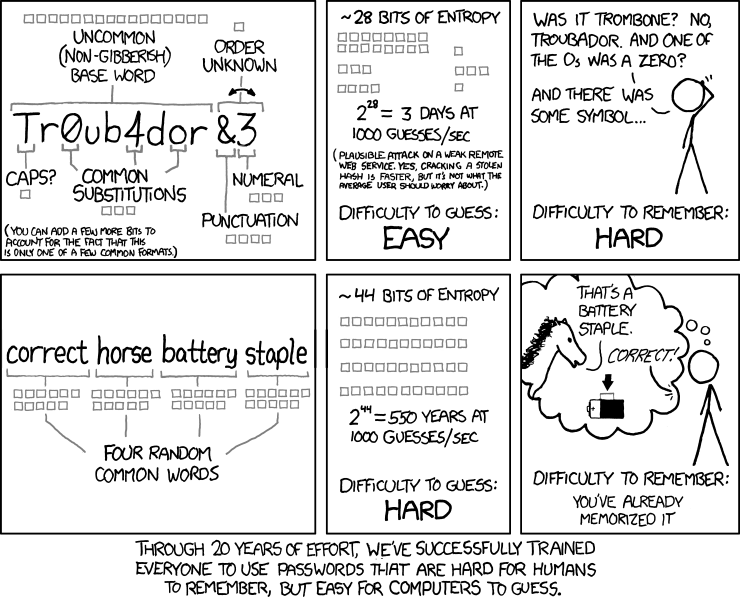
Some time back, I read this interesting post at xkcd, a usual for these guys.

It made me realise, for the zillionth time, passwords are mess. This medium of authenticating a valid, and a human, user has overstayed its welcome. The way it is being used is not secure. Well, can you blame the poor souls who are made to remember the crazy letters every time they want to get something done online? Moreover, they are forced, as a security policy, to change and then remember the new passwords every some time. Sigh! Indeed, passwords are mess.

You need more proof? Try searching for the phrase “passwords should die”. This farce has to be one of the most cursed phenomenon out there.

But then what are the options?

  1. Make browsers/OS’es handle the password generation and management: This is one of the oldest and most recommended solution for this issue. The problem is such machine generated passwords are usually random Strings; hence they are extremely hard to memorise. Good password managers can negate that need. However, they become a hinderance in an environment where there are multiple machines involved (for example, work vs home environment). Moreover, the security aspect of these are hotly debated topics.
  2. Recommend ways for easy to remember, difficult to break passwords: An option that is evaluated a lot these days. The xkcd post linked above recommended one such way. It also opened a lot of threads discussing and analysing the accuracy and feasibility of the same. There were articles and papers written on understanding and improving on the suggested way. The problem is, eventually, it is a human, the lazy ass, who will decide what the password would be. What would end up happening is instead of ”password1” being a common password, it would be ”mypasswodiscommon”.
  3. Go Biometric: Apple introduced a working and, debatably, secure implementation of biometric authentication in TouchId. By bundling it as a core feature of iPhone, Apple made it reach to the masses. Tons of articles were written detailing how it can solve the password problem altogether. Though possible, issue remains this would not happen until biometric authentication comes bundled across all technology devices, even the low-end mobile phones. Passwords remain the standard, and only acceptable authentication method till then.
  4. Make passwords die, altogether: Finally, we come to the most interesting option that can be driven by the application developers themselves and not the users of the application. I feel, this will eventually become a reality.

Password-less Authentication

A lot has been said on this front too. There are articles and even open source frameworks, like Passwordless that want to target this by providing application developers ways to replace their login forms with password-less access. At high-level, key steps involved to achieve this are

  • Make a user just mention his userid/email address
  • Generate a one-time token for him
  • Deliver it to him
  • Authenticate him with the generated token

These are pretty standard and well accepted steps. However the issue remains in the 3rd step, how should these tokens be delivered. Whichever mechanism one selects will become the single point of threat to the whole system going haywire, be it then email (what’s the password for email account then?) or SMS (phone is lost, what now?). The hacker news thread on one such suggested system is nice rundown for the probable issues.

Now that thread is more than a couple of years old. Today, the best option would be to deliver the token to the device which has biometric authentication enabled. As an example, I really like the way Apple has enabled the two-factor authentication on Apple Id. It displays possible devices where the token can be delivered and asks the user to select one. Once delivered to, say, an iPhone, only the user who owns the iPhone can access it by authenticating himself with TouchId. This same mechanism can be applied for delivering the secure tokens of web/mobile applications too. There, the delivery problem is solved.

However, given that majority of the users do not own an iPhone or a similar biometric authentication enabled device, this method cannot become the primary way of authenticating users.

So even though I believe that, in John Siracusa’ words, on an infinite timescale, all applications will have password-less logins, we are some years away from realising that dream.


Ok, so what till then? This is what I would like the applications developers to do to make this password mess a bit less itchy for me. Decide first, do you really need me to secure my profile via a password? User forums/discussion groups, I am looking at you. I will give leeway to banks/financial apps to make me remember and enter the password. For all others, please make this process simple.

  1. When a user visits the first time, ask for his email id/mobile number. Next, make him choose a word, an image or, preferably, a set of words/images to remember as “password”.
  2. For every subsequent visit, just ask him for the email id or mobile number. Even better, just do not ask him anything. Maintain his profile information in cookie with expiration set for a longer timeframe.
  3. Give him the options amongst which lies his password and make him “select”, not enter, that as the password. He gets a couple of chances, else make him fall back to one-time token.
  4. If he does not remember the chosen password, or chooses not to, a click on a link sends him a token on email/mobile which he used while registering.

I believe this will ease the burden from majority of the people of maintaining the passwords without making them any less secure. Passwords can’t die yet, but at least they would be a little less painful.

Thoughts on The Martian

This novel has left me with a lot of thoughts. First off, I am totally confused on what I really feel about this. It is one of the most difficult books I found to review. So I just won’t. I do not think I would be able to word my thoughts well. Well, they are confused.

So I would instead refer to one review that I completely concur with. Thomas has done a great job reviewing this at Goodreads. Here’s how he describes the style of prose in the novel, the survival” journey of Mark Watney.

Watney discovers a problem. Watney worries for a sentence or two. Watney comes up with a solution. Watney enacts the solution with minimal struggle. Watney celebrates. Rinse and repeat.

There, Thomas has described what goes on in 75% of the pages. Sigh! This guy Watney is an unbelievable genius. No trouble or challenge is big for him. He glides over every challenge as one would with a game of toys. Actually that’s exactly how Andy Weir, the author, writes this; as if he is Andy from Toy Story spinning an action-drama around Woody during his play time. Throw anything at him, he would have the smarts, the resources and the luck with him to soar out of it. And you know right that at the beginning of every log Watney writes.

There lies the novel’s biggest drawback. It just has one tone, the tone of success. And you can’t build a thriller if the reader is just not thrilled for the protagonist.

To sum up, this is what Thomas has to say.

My overall thoughts on The Martian center on its lack of introspection and repetitive descriptions of action, its disconcerting lack of characterization, and the drought of struggle each of the characters underwent. Watney faces a difficult situation, but I at no point in my entire reading thought he would suffer, based on his Pollyanna tone.

Completely agree. I do not think Andy Weir wanted to write a thriller about a Martian. He wanted to jot down his thoughts on what will it take scientifically for a guy to survive on Mars. And the novel is a breezy light log of these thoughts. You can skim through it without getting involved, like any science paper/theory you read.

All said, this is a nice fleet of thoughts, dreams of Andy Weir. The efforts that Andy Weir has put in that included extensive research into orbital mechanics, conditions on Mars, the history of manned spaceflight, and botany” for the novel shows. A one time read for sure just for that. Just don’t look for a thriller in this and you should be fine.

My rating: 3 of 5 stars