What’s the first thing that pops into your mind when you hear the word “India”? What’s the second thing? And if you search for the stock images with the word, do the results reflect your thoughts? For many that I know of, the answer is always in negative.
You Write Because You Have To
Hello Friend,
After a prolonged slump in my productivity, I’ve been writing a lot more recently. I’m not sure what has brought in this change. Some alteration in the environment I write in had stimulated such a turn around in the past. A new keyboard. A new platform. Or a new place.
However, my selection of tools has hardly changed this time. It’s never the tools, I keep telling myself. Such tool-induced changes in habits are short-lived.
This recent quote from Halle Kaplan-Allen is pretty profound in that sense.
The best tool to achieve any task is the one that you are going to stick by. Tool proliferation leads to increased complexity, and increased complexity leads to productivity paralysis.
I recently came across a sudden surge of posts where a new tool inspired many people to get back to writing. Each person had a new idea that the said tool would help them in. “The simplicity kills the friction; that should help me write more,” goes the thought. That line of thinking should work, sure. But for the majority of us, our minds aren’t wired that way.
Judy Blume says, “you don’t write because you want to, but because you have to”. She is spot-on; I never want to write. I can’t force my mind to sit at the keyboard and fill the pages with words. I only write when I am emotionally involved in what I write. In short, I write best when I believe in what I am writing. Otherwise, all the words are hollow. The thoughts, meaningless. So, I welcome my recent creative phase.
Anyway, here’s a selection of this edition’s three brilliant works of writing. I hope they inspire you to write as well as you can.
A Personal View on Writing – by Judy Blume →
I once met a woman who wanted to write. She told me she’d read 72 books about writing but she still couldn’t do it. I suggested that instead of reading books about writing, she read the best books she could find, the books that would inspire her to write as well as she could.
Those of us who write do it because there are stories inside us burning to get out. Writing is essential to our well-being. If you’re that kind of writer, never give up! If you start a story and it isn’t going well, put it aside. (We’re not talking about school assignments here.) You can start as many as you like because you’re writing for yourself. With each story you’ll learn more. One day it will all come together for you.
The Perfection of the Paper Clip →
Minimal, relentlessly plain, and instantly familiar to a contemporary eye even in an advertisement from 1894, its persistence has made the paper clip the epitome of the disposable, anonymous, manufactured object. It is made for secretaries, for assistants, for subordinates and gofers. It only became most useful once there were millions of pieces of paper that had to be grouped, but that also had to be taken apart again. The staple may contain more potential for physical harm, but the threat of the paper clip is Sisyphean: once you’ve clipped the papers together, you’re probably going to have to unclip them, and then clip together some others, and then unclip those and keep going until you retire, or you get that break in your acting career. Perhaps if Microsoft had chosen an object less reminiscent of mindless toil, the optimism of its much-loathed Clippy office assistant would have seemed less demented, and thus less prime for ridicule.
How to Tell a Story and Others – by Mark Twain →
The humorous story is told gravely; the teller does his best to conceal the fact that he even dimly suspects that there is anything funny about it; but the teller of the comic story tells you beforehand that it is one of the funniest things he has ever heard, then tells it with eager delight, and is the first person to laugh when he gets through. And sometimes, if he has had good success, he is so glad and happy that he will repeat the “nub” of it and glance around from face to face, collecting applause, and then repeat it again. It is a pathetic thing to see.
Very often, of course, the rambling and disjointed humorous story finishes with a nub, point, snapper, or whatever you like to call it. Then the listener must be alert, for in many cases the teller will divert attention from that nub by dropping it in a carefully casual and indifferent way, with the pretence that he does not know it is a nub.
Postscript
Have any recommendations or feedback for me? I’d love to hear from you. Just hit reply, or you can even email me.
Thank you for reading and sharing.
-Amit
I cringe when someone uses the phrase “normal people” while describing a section of a service’s users. Is that the best usage of the phrase? What does it make me, one who doesn’t use the service in the “normal” way? Abnormal? Why would you call your user that?
My daughter has been reading short storybooks since she was 5. She likes to read – she would find a comfortable corner for herself and start reading her books. I was a bit cautious introducing her to a full-length novel, though. I didn’t want to dampen her interest in reading by the usual wordiness of the novels.
But recently, she asked me for some big books – “I am bored with these small stories,” she said. “I know them by heart now.”
So, I did give her a couple of “big” books last week, and she hardly goes anywhere without her book since then. She carries a pencil and an eraser, underlines words she doesn’t understand well, bookmarks pages. Ah, I’m so happy to see her so engrossed while reading. I wish I had started reading sooner; I’m delighted to see my daughter has.
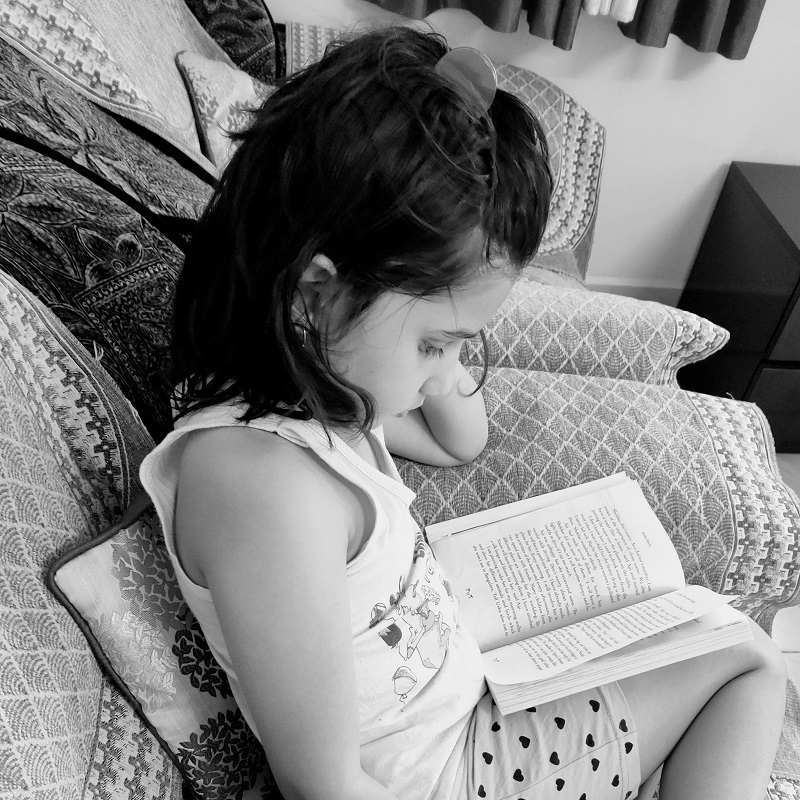
Oh, recently I have seen another habit of hers. She likes to copy small stories into her notebook, then read them in her handwriting and out loud in her voice. Yay!
I wish she keeps her interest in reading intact as she grows and would assist her in whichever way possible. To start with though, I need to choose the right books.
Who is Ghost targeted at? Why is everything around this service so pricey? I understand that it provides the self-hosted option - but that ain’t cheap either. When all such services charge anywhere bewteen $5-$10, why are most options for Ghost around $20? What’s so premium?
I’ve removed all the custom fonts, something that I’ve been extremely picky about, from my site now. This has drastically improved the load times across the pages, at times loading within a second. Sure it does lose the personality, but I’m ecstatic with the benefits.
Wow, there has been a deluge of Hello messages written to the “world” today. The world must be feeling overwhelmed, wondering what ruffled us earthlings today 😬
Slanting Nib Returns With Vol. 2
Hello Friend,
It’s been a while since I published the last issue. For me, neither 2020 signed off on a high note nor 2021 started with a blast. The many unwanted bumps through the challenging past three months forced me to push the reset across my projects.
Anyway, I plan to revive this newsletter, and I intend to call this an unrelated sequel to the original run. The first volume was about and for the writers, whereas I target a slightly wider audience with this reincarnation.
Each new volume of anything generally diverges on the theme; this one is no different. I’ve covered all the aspects I’d planned for the first volume of this newsletter, the one I had tagged as “a writer’s toolkit”. It is disrespectful on my part then to publish something that does not excite me - it cannot be engaging for you, the reader.
What changes can you expect, then?
Well, the soul stays the same. It’s the content and the context that changes. Each issue will still feature three fantastic works of writing, but I won’t restrict them to be only about and around writing. They will be curious at most times. At times, they will be profound. But engrossing they will be every single time.
With that said, here are the three featured writings for this week.
"Advice to Youth" by Mark Twain →
Always obey your parents, when they are present. This is the best policy in the long run, because if you dont, they will make you. Most parents think they know better than you do, and you can generally make more by humoring that superstition than you can by acting on your own better judgment.
"Joy" by Zadie Smith →
“You’re being the dog,” our child said recently, surprising us. She is almost three and all our private languages are losing their privacy and becoming known to her. Of course, we knew she would eventually become fully conscious, and that before this happened we would have to give up arguing, smoking, eating meat, using the Internet, talking about other people’s faces, and voicing the dog, but now the time has come, she is fully aware, and we find ourselves unable to change. “Stop being the dog,” she said,“it’s very silly,” and for the first time in eight years we looked at the dog and were ashamed.
"Go Gentle Into That Good Night" by Roger Ebert →
“Kindness” covers all of my political beliefs. No need to spell them out. I believe that if, at the end of it all, according to our abilities, we have done something to make others a little happier, and something to make ourselves a little happier, that is about the best we can do. To make others less happy is a crime. To make ourselves unhappy is where all crime starts. We must try to contribute joy to the world. That is true no matter what our problems, our health, our circumstances. We must try. I didn’t always know this, and am happy I lived long enough to find it out.
Postscript
Have any recommendations or feedback for me? I’d love to hear from you. Just hit reply, or you can even email me.
Thank you for reading and sharing.
-Amit
Smile With Your Eyes, More
It happened again as I was on my morning walk today, passing through the familiar lanes. I have become habitual to communicate mutely, through smiles, with the folks I have acquainted with over such daily walks.
That uncle who ambles but never forgets to straighten up somewhat every time he sees me. That guy jogging with his headphones on yet makes a point to slow down to acknowledge my presence.
And I connect with many such folks (who I know I don't "know") daily for months and years now. Or at least I try to.
You see, it was easy to do that when we weren't living our life through this dreaded pandemic. When masking the major part of our face wasn't necessary. When we could spread our lips in a smile at someone, and say so much unsaid.
I am struggling to do that these days. I do smile, but I am not confident that the feeling touches the person. Or he or she reciprocates it.
I have heard our eyes convey our feelings. Convey if we are smiling a happy smile. Or are discomfited. Or are pained. For that matter, they unveil even if we are unaffected, disinterested.
But how am I to know for sure if mine did? Or even if the eyes did, my "friend" could sense it? The whole situation is unfortunate. We were thrown blind into this pit without being armed with the proper knowledge to live through such limiting lives.
With our masks always on, we now have put our eyes under undue expectations.
No! How can this be?! I’ve read only fifty-two per cent of this damn book?
No! How can this be?! That’s exactly me, reading.
Is there a threshold of word count that when hit, and only then, an essay or a book will be considered notable? Or what is communicated be taken seriously? If not, why do I see authors unnecessary lengthening the prose?
Come to the point, make it with conviction and sign off.
Just a few pages in and I was excited to read Factfulness by Hans Rosling. Given the times we are living in today, whoever claims that “the world, for all its imperfections, is in a much better state than we might think” has my attention.
March is yet to begin and the Summer’s already here. The room coolers are out. The earthen pots that store the water are out. And watermelon is in the home! AC, fridge and icecreams don’t bring the same joy to me.
Anyway it’s close to 🍉'o clock 😁
I finished reading Endless Night by Agatha Christie and am not at all impressed. This review might contain spoilers, but I can’t help I have to rant.
Nah, I am not letting the ending influence the overall rating for the book again. It is easy to get wowed by the intelligent ending and rate this book highly. But it wasn’t a good read for me.
Right from the start, I didn’t trust the narrator. I guess I’ve been fooled by many first-person narrations for my liking. Michael is a poor narrator - not sure if it was intentional on Christie’s part. None of his actions, his reactions made sense to me, further heightening my suspicions about what I was being told by him. So the twist towards the end fell flat - it was as if I already knew deep down and was just waiting for it to be revealed.
Oh, and I was waiting a lot of time throughout the book. 2/3rds in and there is hardly anything that takes place. To me, the love story between Mike and Ellie was not interesting. The way it played out was dull. It got tiring at one point to read Mike tell what was happening. The suspense around Gipsy’s Acre wasn’t built at all. It was supposed to be a “gothic story with gypsy’s warnings” - wasn’t the case.
This may have been a brilliant psychological thriller for its time. But a lot has happened since 1967 and too many have been inspired by the style of surpriseful narration from this mystery master for this style to create the necessary impression anymore. This read was so unlike any other from Agatha Christie and this time it is not in positive sense.
On Personal Names...
I have a pretty common first name (or given name as it is called at some places). It’s so common that even the movie characters with my name have rarely had any significant part to play. I believed my surname was uncommon, making the combination unique. But I was wrong with my assumption – boy there are so many Amit Gawande’s out there on Facebook, the “universal phonebook”. Yo namesake morons, why are you still using that app?
The names from European countries always fascinate me 1. Every name sounds so unique. And has such a complex tone to it – it’s new every time I hear it. And if I think I’ve already heard it, they adorn the spelling with an extra “z”. Fantastic!
Having a common first name sucks. Having it end with an equally common surname sucks more. Good luck getting high up the search results list 2. I dread creating my account on any new service that is launched. I rarely get a username with just my first name – there is already a developer building that bloody service. With surname? Nah. With the first letter of surname? Nah. With a number or underscore in there? Yep, that’s what you get.
That also the reason why I respect the service where I could get that username with just my first name. Uhm!
Of course, if your aim in life is just to get lost in the crowd, be not know or just be, have a common name. But who wants that? Right? RIGHT?
-
Not English names though – why won’t you patch up your relationship already. It will save us other worlders the effort of clarifying this every time. I know, I know. As if you ever gave a shit about what we thought. Sigh! ↩︎
-
Yep, am not pure. I do Google my name often. As if you don’t. Bruh! That’s also another reason why I love DuckDuckGo – I am the “top” Amit Gawande amongst all other suckers out there. ↩︎
Why is it that it's only the Mac, iPhone, or iPad apps that work well with the Indieweb principles? Say, for example, integrating well through a micropub endpoint? Are all Indieweb app developers in the Apple ecosystem?
I don't like GitHub's dark theme - it's painful to my eyes. There's too much contrast between the dark background and the lighter fonts. It's not simply about going white on black - getting the balance of shades right is not a trivial thing.
Sometimes I get afraid of tapping that YouTube app. It just drains too much of my time - even with all my efforts to make the service a lot less addictive. I fear this service even more than any social media app out there. I know I will start with something interesting, but will eventually start watching the same old videos that I've already seen.
It is easier to stop myself going in than to convince myself to come out. Inertia much?
I only recently came across this wonderful Netflix show Manhunt: Unabomber. Boy, it was brilliant - No idea how it missed my radar. Such a thrilling story narrated in an engrossing manner. Masterful, intelligent and affecting.
Dropbox can also store your passwords now with their password manager - and it’s built into their Plus and Professional plans. This could be a good option for those affected by the LastPass change to their Free plan.
Not for me though - am not (yet) a paying Dropbox customer. I don’t know till when that can last. Appears to me that all services I use are reconsidering their free tiers.
For all the non-iOS users, what’s the Android phone that you currently use or are planning to upgrade to?
(That question also brings a sad reality of duopoly that the exists today.)
Of course, there had to be a term decision fatigue - “the emotional and mental strain resulting from a burden of choices”. It has to be the king of all fatigues. It leaves you paralyzed. What’s worse is you still go through your motions as if everything’s normal. Pathetic!
I know password manager's an important service and one shouldn't hesitate to pay for it. But LastPass's free tier was a good enough option for me; there was no feature that I needed to pay the subscription price for. That changed with today's modifications to that free tier.
That update also made me reevaluate my options. And I realized 1Password is a better option for me -- both in terms of the features and the cost it charges (especially in Indian market).
So I've ditched LastPass the moment they asked me to pay. Is that cheating?
Is today’s doomscrolling a severe variant of 2007’s wwilfing? I’d, for sure, suffered from the later during my early blogging days. We humans have since long mastered two things – finding the most boring ways to kill our productivity & naming them in the most creative manner.
I read a headline “The science of reasoning with unreasonable people”. Why would I do that?